Private-sector expatriates in Kuwait cannot simply book a flight and leave. Workers on Article 18 visas must obtain an electronic exit permit approved by their employer before travelling abroad—whether for a holiday, work trip, or permanent departure. The Public Authority for Manpower (PAM) says the requirement applies to expatriate workers before any departure from Kuwait. It covers private-sector employees travelling temporarily or permanently, whether by air, land, or sea.
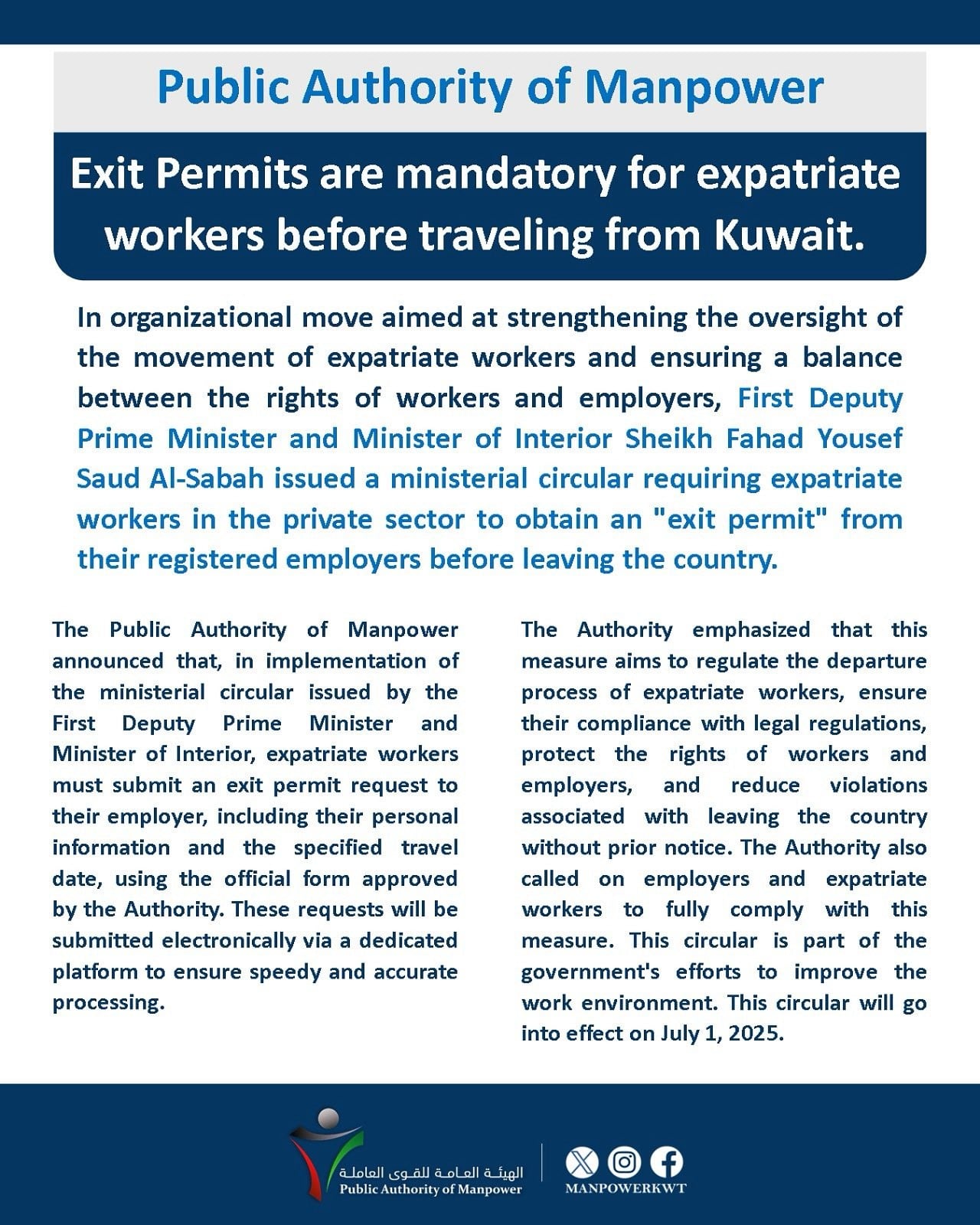
The rule took effect on July 1, 2025, under a ministerial circular issued by First Deputy Prime Minister and Minister of Interior Sheikh Fahad Yousef Saud Al-Sabah. PAM announced the measure in an official statement, saying it aims to regulate departures, protect the rights of workers and employers, and curb unauthorized exits.
Workers must file the request between seven days and 24 hours before departure. Under the single-trip option, the approved permit is valid for seven days and covers one departure.
Multiple-Trip Permits Now Available
PAM has since added a multiple-trip option. It replaces the previous one-trip-only limit and lets applicants choose a validity period for their permit.
The change is aimed at frequent travellers who would otherwise need a new permit for every departure. Workers can access the service through the As’hal Companies/Manpower portal or the Sahel Business/Individuals application.
Both employers and employees can print the exit-permit form when needed. PAM says the upgrade cuts processing time and supports the digital transformation of government services.
Employers Can Pre-Approve Travel
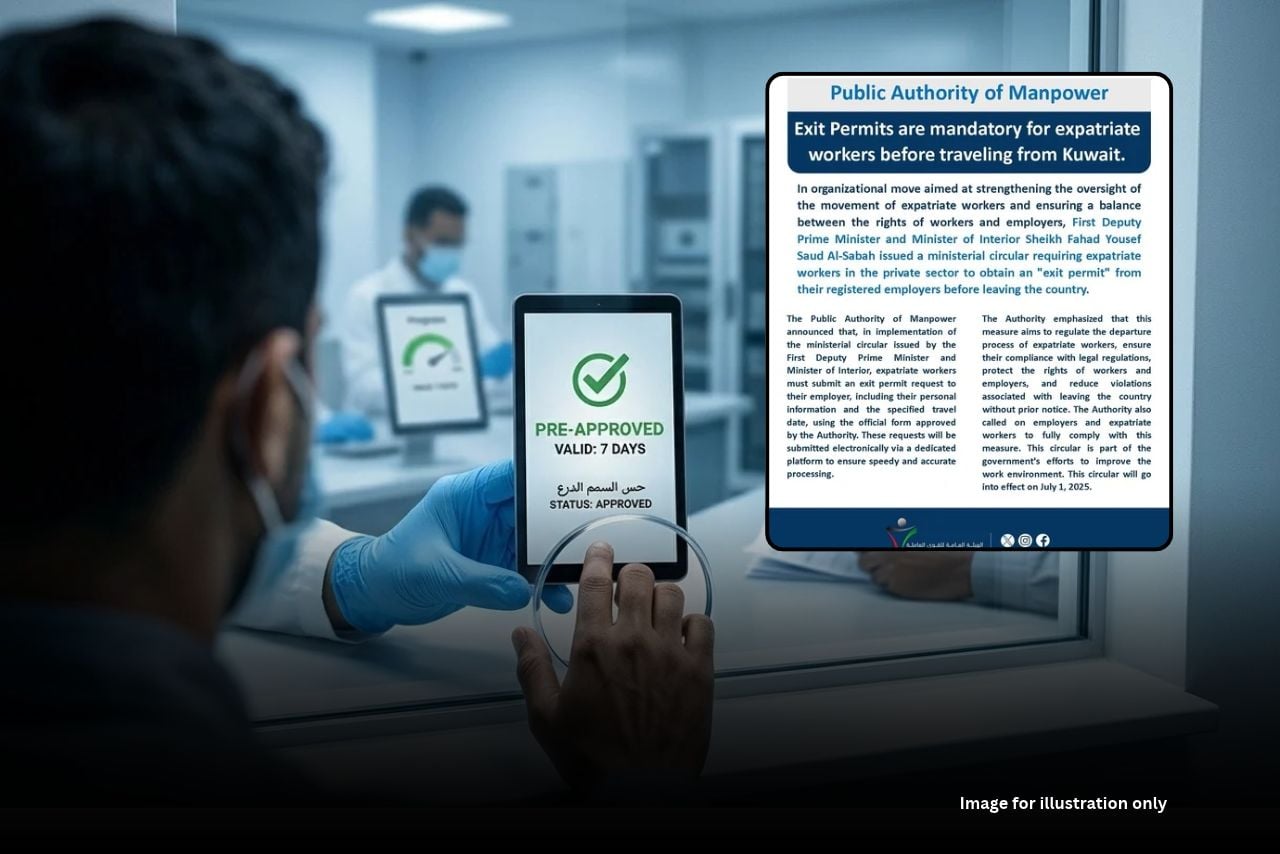
Employers can also grant automatic prior approval through PAM’s “Pre-Approval of Exit Permit” service. An authorized signatory can approve permits in advance, removing the need to sign off on every request.
Employers can apply the pre-approval to:
- One employee
- A selected group
- All workers under a specific licence or file
They can exclude certain employees through an exception system. Once a worker applies, the permit is issued automatically.
Employers still control the arrangement. They can revoke or cancel pre-approval at any time.
Who Needs a Permit
The requirement applies to private-sector expatriate workers, commonly referred to as Article 18 visa holders. It does not matter whether the trip is for leisure, work, or a permanent move abroad.
Exit Permits are mandatory for expatiate workers before traveling from kuwait #الهيئة_العامة_للقوى_العاملة #manpower_kuwait https://t.co/7q56jSqjgw
— الهيئة العامة للقوى العاملة (@manpowerkwt) June 17, 2025
Some workers are exempt:
- Kuwaiti citizens
- Article 20 domestic workers, including maids, drivers, and cooks
- Dependants sponsored under family residency
For everyone else in the private sector, employer approval is part of the departure process.
How to Apply
Employees apply using their Civil ID through the Sahel app or the Ashal portal. The employer then reviews and approves the request electronically through Sahel-Business or Ashal.
- Apply no more than seven days before travel.
- Submit no later than 24 hours before departure.
- Use the Civil ID to file the request.
- Wait for the employer’s electronic approval.
- Travel within the seven-day validity period.
A missed deadline or an unapproved request can leave a worker unable to leave the country as planned.
What If the Employer Refuses?
An employer cannot simply block a worker’s travel without consequence. If approval is withheld without justification, or if the system shows a data error, the worker can report or appeal to the Public Authority of Manpower (PAM).
The rules do not say every refusal is unlawful. But they do give workers a formal route to challenge a decision or fix a technical problem.
Why It Matters
The exit-permit system has drawn renewed attention as Kuwait faces scrutiny over its treatment of migrant workers. At a United Nations hearing in August 2026, Committee on the Elimination of Racial Discrimination experts raised concerns about reported mass expulsions and restrictions on migrant workers changing jobs.
Committee expert Ibrahima Guisse said Kuwait’s residence law prevents migrants from changing jobs or sectors without initial employer approval. He also cited reports that around 40,000 migrants were forcibly deported from Kuwait in 2025.
Kuwait’s delegation told the committee that Law 114 of 2024 regulates employment and residency arrangements and that the state is developing contractual frameworks to give workers greater freedom to transfer jobs and retain their documents.
The delegation also said administrative deportation is based on objective legal measures, applies only in grave cases, and is regulated by 2025 legislation that limits detention to 30 days, with possible extension.
What Workers Should Do
Before booking a flight, workers should confirm whether they fall under the exit-permit requirement and follow the application process carefully.
- Check your visa category before booking travel.
- Apply within the required window.
- Keep proof of approval and the permit’s validity dates.
- Contact PAM if approval is withheld or the system fails.
- Do not assume every traveller needs a permit; exemptions apply.
For private-sector expatriates, the rule is: no employer approval, no exit.