Kuwait has retained its Tier 2 ranking in the US State Department’s 2026 Trafficking in Persons Report, marking the second straight year the country has held the classification.
The report credited Kuwait with stepping up its response to human trafficking, particularly in investigations, prosecutions, and victim support. For the expatriates, this report touches on issues that affect workers’ daily lives, from wage disputes to recruitment fees and access to help when things go wrong.
Justice Ministry Undersecretary Awatif Al-Sanad, who is also vice-chair of Kuwait’s National Standing Committee to Combat Trafficking in Persons and Smuggling of Migrants, said the report recognized the country’s stronger efforts against human trafficking. She told the Kuwait News Agency (KUNA) that authorities recorded more cases investigated, more suspects prosecuted, and more convictions secured than in the previous reporting period.
The report also noted that more victims were identified and referred to care services, while funding for victim support increased. The US State Department’s Kuwait page said the government reported investigating 11 trafficking cases, prosecuting 64 suspects for forced labor, and convicting two traffickers during the reporting period.
What Tier 2 Means
A Tier 2 ranking means the US report does not consider Kuwait to have fully met the minimum standards for eliminating human trafficking. However, it recognizes that the government is making significant efforts to address the problem.
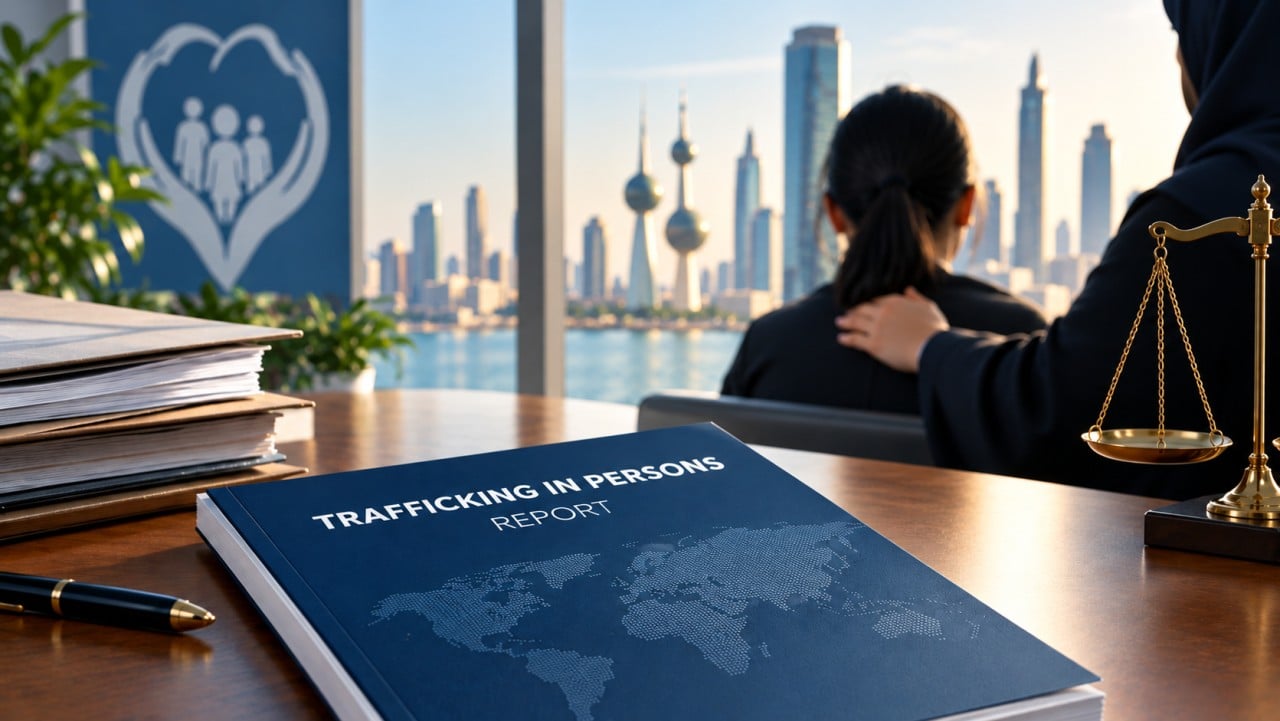
For expats, this matters because trafficking cases often overlap with labor problems many workers already know too well: unpaid salaries, withheld passports, excessive working hours, recruitment debt, and employers restricting movement. These situations do not always lead to a trafficking case, but they can put workers in vulnerable positions.
The report’s focus on victim identification and referrals is particularly relevant for domestic workers, drivers, and others working in private homes, where abuse can be harder to spot and report.
What the Report Found
According to Al-Sanad, the 2026 report cited progress in several areas:
- More trafficking investigations compared with the previous period.
- Increased prosecutions and convictions.
- More victims identified and referred to care.
- Higher funding for services supporting victims.
- Recognition of the efforts of national authorities involved in enforcement and protection.
The numbers reported by Kuwait—11 investigations, 64 prosecutions, and two convictions—show that cases are moving through the system. Still, the relatively low conviction figure shows how difficult trafficking cases can be to prove, especially when workers are afraid to come forward or lack documents and evidence.
Kuwait Commits to Further Reforms
As a country which relies heavily on migrant labor and a workforce that is highly vulnerable to exploitation through recruitment fees, wage disputes, confiscated documents, and restricted movement, this ranking matters to Kuwait. In fact, trafficking cases often overlap with labor abuses, making effective enforcement and accessible complaint channels critical. This Tier 2 status can also affect how international partners, employers, and advocacy groups view a country’s labor protections. While it does not trigger automatic sanctions, it places a government under continued scrutiny and sets a benchmark for the following year’s report.
Al-Sanad said Kuwait remains committed to strengthening its fight against trafficking and protecting victims. She said the national committee will continue coordinating with concerned authorities to improve procedures and make sure they are properly implemented.
She added that the committee will use the observations in the US report to guide future reforms. The aim, she said, is to strengthen human rights protections and help Kuwait meet its international obligations.
For workers in Kuwait, the practical question is whether these improvements will translate into faster help, safer complaint channels, and better protection for those who report abuse.
The government has not announced specific new measures in connection with the report. Any further steps would likely be outlined through the Ministry of Justice, the Interior Ministry, or the national committee in the coming months.
For now, the Tier 2 classification keeps Kuwait in the same position it held last year: recognized for progress, but still short of the highest US standard for eliminating human trafficking.