Domestic workers in Kuwait are not without protection. Law No. 68 of 2015 sets clear rules on salaries, days off, housing, medical care, and personal documents. Employers must pay wages every month, provide food, clothing, and decent accommodation, and cover treatment at public hospitals. They also cannot keep a worker’s passport or civil ID without consent.
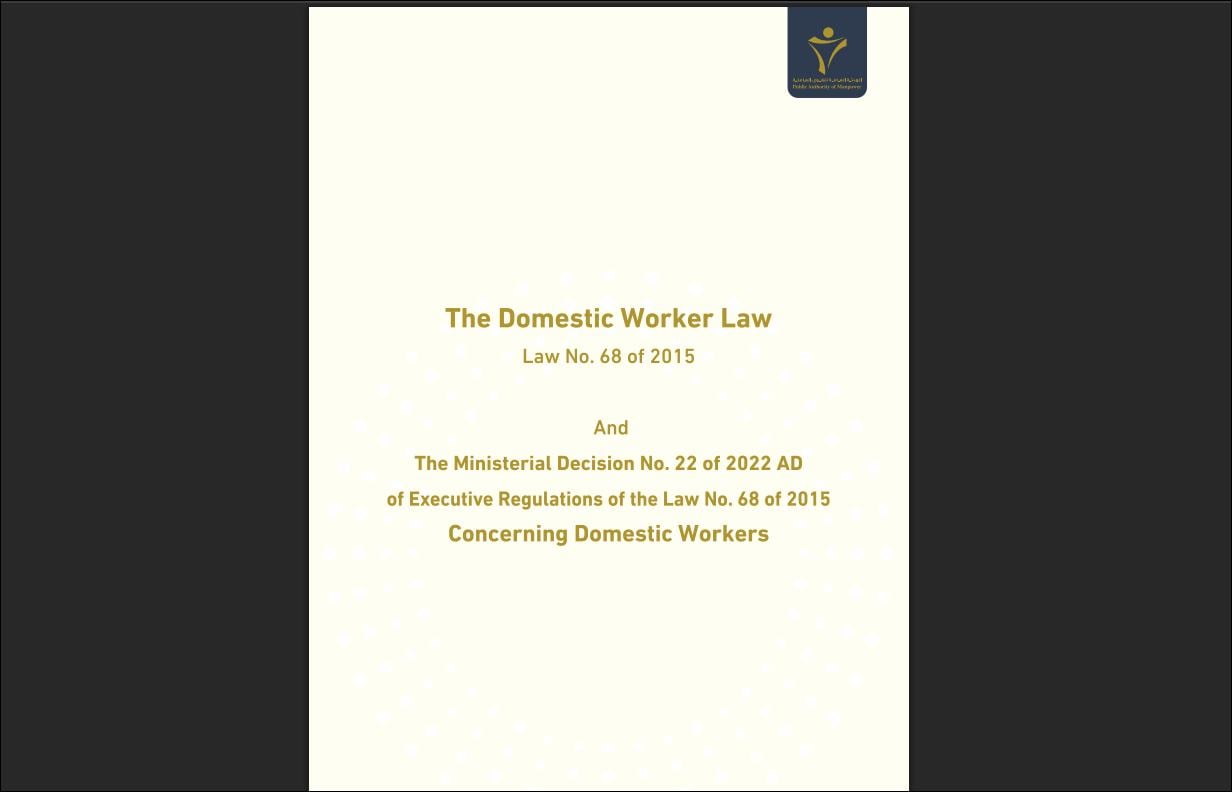
The full text of the law is available through the International Labour Organization’s NATLEX database, which publishes Law No. 68 of 2015 on Employment of Domestic Workers. Its implementing rules, under Ministerial Decision No. 2194 of 2016, spell out the duties of employers, recruitment agencies, and domestic workers. For many helpers working in Kuwaiti homes, knowing these rules can prevent problems before they start.

What You Are Entitled To
Domestic workers have the right to:
- Monthly payment of the agreed salary, which cannot be below the minimum wage set under the law.
- A receipt for every salary payment.
- Food, clothing, and housing that meets basic health and living standards.
- Medical treatment at public hospitals.
- No more than 12 hours of work a day, including rest periods.
- A paid weekly rest day and paid annual leave.
- Compensation for up to two hours of overtime a day, equal to half a day’s wage.
- One month’s wage as indemnity for every year of service, if the contract is completed.
The employer must prove that wages were paid. A bank transfer, salary receipt, or other payment record can serve as evidence.
What Employers Cannot Do
The law bars employers from:
- Keeping a worker’s passport, civil ID, or other identity papers without consent.
- Requiring work that endangers the worker’s health or safety or violates human dignity.
- Sending a worker abroad or employing them for someone else without consent.
- Delaying wages beyond the agreed payment date.
- Ignoring a valid complaint filed with the Domestic Workers Directorate.
Late pay carries a penalty. Aside from the unpaid salary, a worker may claim an additional KD 10 for every month of delay. A valid complaint can also suspend an employer’s ability to hire new domestic workers for six months.
Read Your Contract Before You Sign
Before work begins, the employer must sign a recruitment contract using the form approved by the Domestic Workers Directorate. In a dispute, the Arabic version prevails.
When the contract ends, the employer must release all dues owed to the worker. The contract renews automatically unless either party gives notice at least two months before expiry.
Keep copies of your contract, salary receipts, transfer records, and messages about work arrangements. These can make a complaint easier to prove later.
What To Do
In case you are already employed and you encounter these situations, here’s what you need to do:
If Your Salary Is Late
A delayed salary should not be brushed aside. Secure proof of the agreed wage and payment dates first.
You may file a complaint with the Domestic Workers Directorate or the Public Authority for Manpower (PAM). If the complaint is valid, the Directorate can extend your residency until the case is resolved and your dues are paid.
PAM launched electronic services for domestic labour disputes in 2023. Workers and employers can submit complaints through the electronic forms portal, attach documents, and complete the application at the Regulating Domestic Labour Recruitment Department.
If Your Passport Is Being Held
Your passport and civil ID belong to you. An employer may hold them only with your consent.
Avoid confrontations that could put you at risk. Keep messages requesting the return of your documents and seek help from PAM, the Domestic Workers Directorate, or the Philippine Embassy in Kuwait.
If You Get Injured
Your employer must arrange treatment at a public hospital. For a work-related injury, the employer must also cover treatment and compensation.
Report the injury right away and ask for medical attention. Keep records of what happened, the treatment you received, and any related messages.
How to File a Complaint
If you believe your rights were violated:
- Gather your contract, ID details, salary records, receipts, messages, and other evidence.
- File a complaint with the Domestic Workers Directorate or through PAM’s electronic forms portal.
- Attach supporting documents and provide accurate details.
- Complete the required in-person step at the Regulating Domestic Labour Recruitment Department.
- Contact the Philippine Embassy in Kuwait for consular assistance, especially if safety or withheld documents are involved.
PAM also offers a confidential “Report Me” service through the Sahel application for reporting labour violations, including concerns involving recruitment offices.
Do not sign papers you do not understand. Ask questions, seek help, and use official complaint channels early. Kuwait’s law gives domestic workers real protections—knowing how to use them is what matters.