If you work as a domestic worker in Kuwait, you may be entitled to more money than you realize when your contract ends. Under Kuwait’s Domestic Workers Law, you are owed an end-of-service indemnity equal to one month’s basic salary for every completed year of service. This applies to housemaids, cooks, nannies, family drivers, gardeners, and other household workers employed under a domestic-worker contract.
The entitlement comes from Article 23 of Kuwait’s Domestic Workers Law No. 68 of 2015. Kuwait’s Public Authority for Manpower (PAM) has also reminded employers of this obligation in its official guidance for domestic-worker employers and in a post on its social media account.
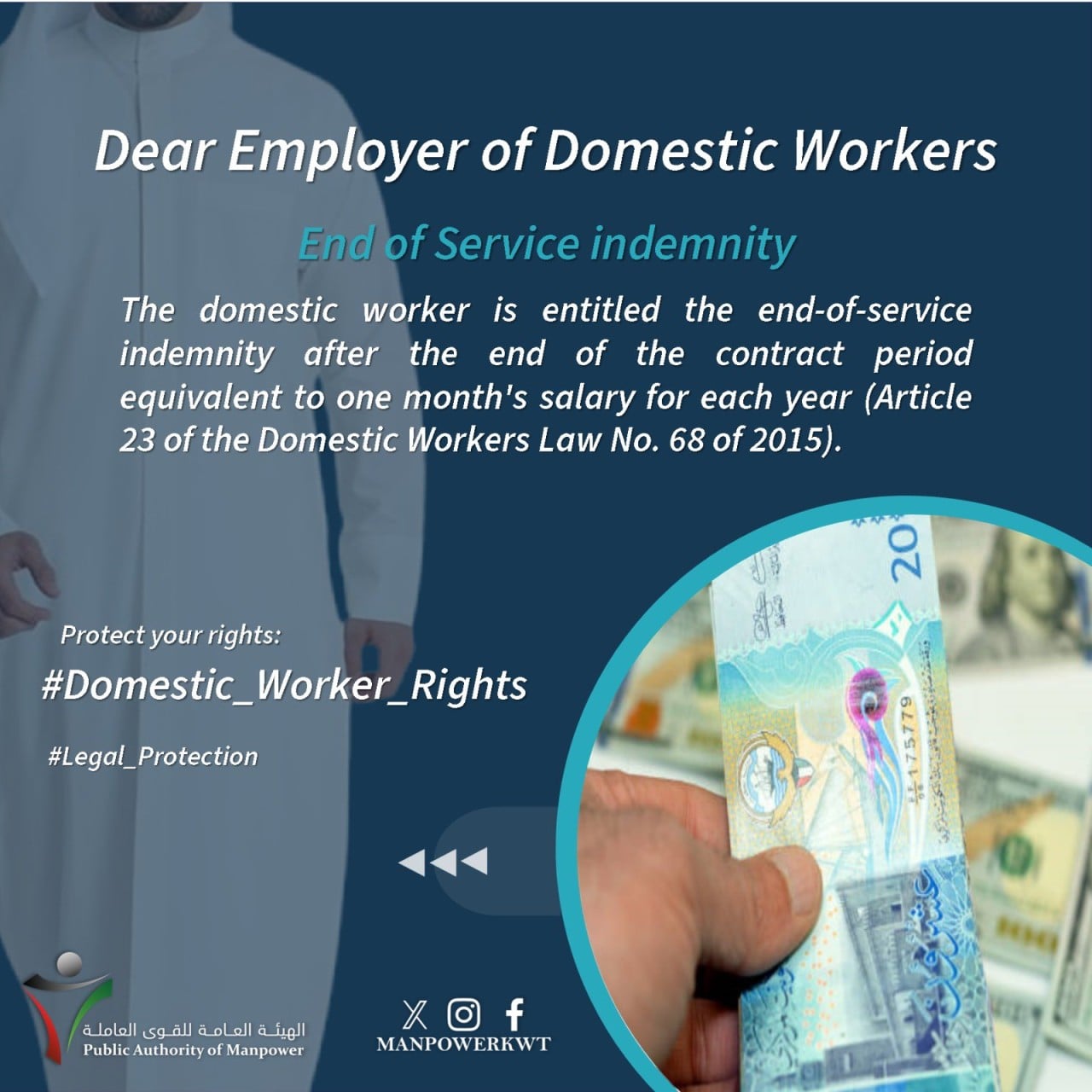
How Much Should You Receive?
Use the basic monthly salary written in your contract—not the value of food, a room, clothing, or other benefits your employer provides.
- Formula: Monthly basic salary × completed years of service
- If you earn KWD 120 a month and finish five years, you should receive KWD 600.
- If you earn KWD 120 a month and finish two years, you should receive KWD 240.
There is no maximum limit stated in the law. However, Article 23 does not explain how a partial year is counted, so if your service ended before you completed a full year, check your case with PAM’s Domestic Workers Department.
Do Not Use a Regular Kuwait Indemnity Calculator
Many online indemnity calculators in Kuwait follow the Private Sector Labour Law, which does not cover domestic workers. That law pays 15 days’ salary per year for the first five years, then one month per year, and caps the total at 18 months’ salary.
For domestic workers, the correct rule is simpler and usually more generous: one full month’s salary for every completed year. Using the wrong calculator could make you accept less than what the law requires.
When Should You Get Paid?
Your indemnity is due after you complete your contract. When the contract ends, your employer must pay everything owed to you under the contract and the law.
- Your contract renews automatically unless you or your employer gives notice at least two months before it ends.
- Your employer must pay your final dues when the contract finishes.
- Your employer must also cover your return ticket at the end of the contract.
- If a domestic worker dies, the employer must pay for repatriation, the wage for the month of death, and any remaining dues to the worker’s family.
عزيزي صاحب العمل (العمالة المنزلية) توثيق دفع الرواتب احمِ حقوقك #حقوق_العمالة_المنزلية #الهيئة_العامة_للقوى_العاملة Dear Employer of Domestic Workers Documenting the Payment of salaries Protect your rights #Domestic_Worker_Rights #manpower_kuwait https://t.co/1ePSGWu6h7
— الهيئة العامة للقوى العاملة (@manpowerkwt) November 5, 2024
Know Your Other Rights
Your rights do not end with indemnity. Kuwait’s domestic-worker rules also protect your salary and working conditions.
- The minimum monthly wage is KWD 75. The old KWD 60 minimum no longer applies.
- Your salary must be paid monthly, no later than seven days after the due date.
- If your salary is late, you are owed an extra KWD 10 for every month of delay.
- Your employer cannot deduct money from your salary for food, breakages, recruitment fees, or any other reason.
- You are entitled to at least 30 days of paid annual leave.
- You must get a paid 24-hour rest day after every six working days.
- Overtime is limited to two hours a day and must be paid at half a day’s wage.
معالي النائب الأول لرئيس مجلس الوزراء ووزير الداخلية الشيخ فهد اليوسف الصباح يلتقي عدداً كبيراً من ممثلي الشركات وأصحاب الأعمال في (الهيئة العامة للقوى العاملة) لبحث قضايا سوق العمل #الهيئة_العامة_للقوى_العاملة #manpower_kuwait https://t.co/B55V8CwW8C
— الهيئة العامة للقوى العاملة (@manpowerkwt) October 22, 2026
If Your Employer Won’t Pay
Keep every document that proves your employment and payments: your signed contract, bank transfers, salary receipts, and residency papers. A signed receipt or bank record can help support your claim.
If your employer refuses to pay your indemnity or salary, file a complaint with PAM’s Domestic Workers Department. A worker’s complaint must be decided within two weeks under the regulations. If there is no settlement, the case can go to court, and domestic workers do not pay court fees.
Once you file a complaint, an absconding report cannot be registered against you. PAM must also extend your residency until your complaint is resolved and you receive what you are owed.
Before signing any settlement or clearance certificate, make sure the money has actually been paid—do not sign simply because you are being asked to.